


DSP
.jpg)
.jpg)
.jpg)
.jpg)
Digital Sound Processor for Car Audio — Why Your System Sounds Wrong and How DSP Fixes It
Put together a solid system and it still doesn't quite deliver. Imaging's vague, vocals aren't sitting right, bass feels like it's coming from somewhere behind you rather than part of the mix. Most people at this point start thinking about another speaker upgrade, maybe a different amp. Usually that's not actually the problem. What's missing is a digital sound processor for car audio handling what no driver or amplifier alone can fix — what the cabin itself does to sound after it leaves the speaker.
Car cabins are acoustically rough environments, and that's putting it charitably. Asymmetric seating position, glass on all sides, hard door panels next to soft headlining, dashboard reflections arriving at your ears from the wrong angle. Every car is basically a purpose-built acoustic problem, and a DSP for car audio is the tool designed specifically to address that, rather than just throw more hardware at it.
The Specific Problems Digital Signal Processor Car Audio Solves
Take the seating position issue. The driver sits closer to the left speaker than the right, sometimes by 20-30 centimeters or more. Sound from the nearer side arrives fractionally earlier, and that millisecond-level difference is enough to blur the stereo image and push the whole soundstage off-center. Digital signal car audio processors correct this by delaying the closer channel fractionally — both sides arrive at the same time, and suddenly the system sounds like it was designed around where you're actually sitting.
Parametric EQ is the other half of what makes this worthwhile. Not the basic EQ slider on a head unit, which shifts broad frequency ranges without any real surgical precision. A digital sound processor car audio unit lets you target a specific peak — the harshness that shows up in door speakers around 3-4kHz at volume, for example — and pull that down without touching the frequencies on either side. The difference between a system that sounds assembled and one that sounds designed comes down to exactly this kind of control.
Our DSP for Car Audio Range
At Enigma, we stock Aura's digital sound processor for car builds specifically because proper signal processing shouldn't be reserved for custom high-end installs. The processing capability that used to need specialist equipment and a dedicated tuning session is now accessible enough to use in a serious build without rebuilding the whole budget around it.
Getting the acoustic side right matters as much as the hardware side. Aura's digital signal processor car audio range makes that a realistic part of the build rather than an afterthought — and in our experience, it's the single upgrade that makes the biggest difference to customers who've already invested in quality speakers and amplification but feel like something's still missing.
FAQs
Got questions? We’ll answer them. If you can’t find the answer to your question here, feel free to reach out to us from our Contact Us section.
Often, more than another hardware upgrade would actually help. A digital sound processor for car audio addresses acoustic problems that better drivers simply can't — time alignment, cabin reflections, and frequency peaks specific to your car's interior shape.
First-time setup has a real learning curve, particularly time alignment and parametric EQ. Most people benefit from a setup guide or a professional first tune. The difference after proper configuration makes that effort very much worth it.
Generally, yes — most digital sound processor car audio units accept standard RCA or speaker-level inputs, so compatibility with existing head units is rarely an issue, regardless of brand or age.
Basic EQ makes broad adjustments across fixed bands. A digital signal processor adds parametric control, time alignment, crossover management, and phase correction — tools that actually address the acoustic problems a car cabin creates rather than just adjusting general frequency levels.
Significantly. Proper crossover management through a digital sound processor for the car means the sub and mid-bass drivers hand off at the right frequency, and time alignment stops the bass from feeling like it's coming from the wrong part of the cabin entirely.
Digital Signal Processor - a unit that processes the audio signal between the head unit and amplifiers. Controls time alignment, parametric EQ, crossover frequencies, and phase correction. The tool that addresses what a car cabin's acoustics do to sound.
Corrects timing differences caused by asymmetric seating position, applies EQ to fix resonances specific to the vehicle interior, and manages crossover points between drivers. Without it, even an expensive system suffers from vague imaging and frequency peaks that nobody fixed.
An amplifier increases signal power. An Aura Digital signal processor shapes the signal before it reaches the amp - timing, frequency response, crossovers. Fundamentally different jobs, which is why combining both gets considerably better results than a powerful amp alone.
Not for a basic upgrade, but genuinely transformative for anything serious. Once speakers and amplification are sorted, an Aura Digital signal processor is usually what makes the system sound designed rather than just assembled.
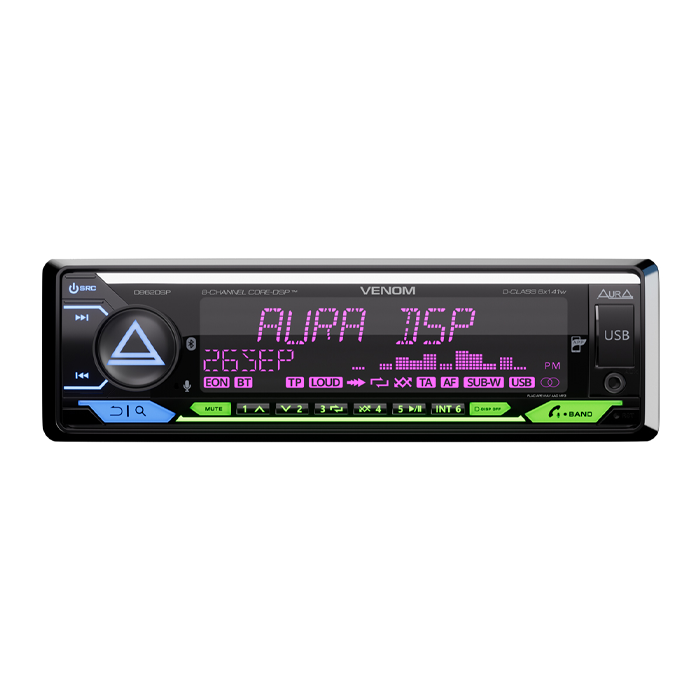
Built-in DSP in units like some of our Aura Digital Media Receivers provides basic processing integrated at the source. An external Aura Digital signal processor gives considerably more control - more channels, deeper parametric EQ, and proper time alignment. Serious builds use external, casual upgrades can work with built-in.
Combo units simplify installation and reduce wiring. Separate units give more flexibility for specific power requirements. For most installs, the Aura DSP Amplifier Combo is the practical choice - separate units suit builds with multiple amplifiers or very specific power needs.
Processes eight output channels independently - enough for front component speakers (tweeter and woofer as separate channels), rear speakers, and a subwoofer, all with independent EQ, time alignment, and crossover settings. Our Aura DSP range covers multi-channel units for both basic and complex configurations.
Aura DSP processors output to amplifiers rather than directly to speakers, so the impedance concern applies to the amp's spec rather than the Digital signal processor. The DSP's signal output impedance is low enough to drive any standard car audio amplifier input without issue.
Yes - one of the Aura DSP's most useful applications. Takes speaker-level output from the OEM unit, converts to line level, applies processing, and feeds aftermarket amplifiers. The original head unit stays; the system sounds dramatically better.
Most Aura DSP units support saving multiple presets - useful for different listening preferences or for keeping a flat, unprocessed profile alongside the tuned one for comparison.
Yes - Aura DSP units support app control for adjusting settings in real time from the listening position, which is considerably more practical than a physical controller for detailed parametric work.
Available for Android. iOS compatibility depends on the specific model - check to confirm iOS support for the unit being considered.
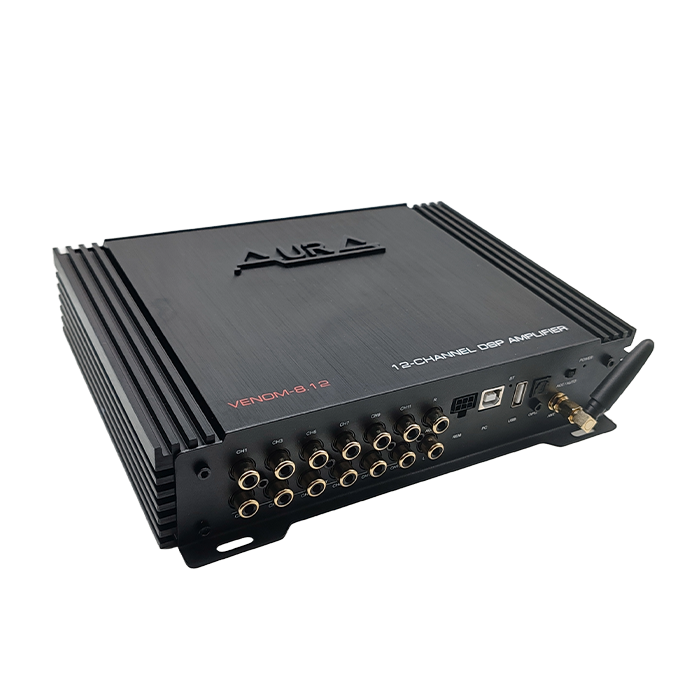
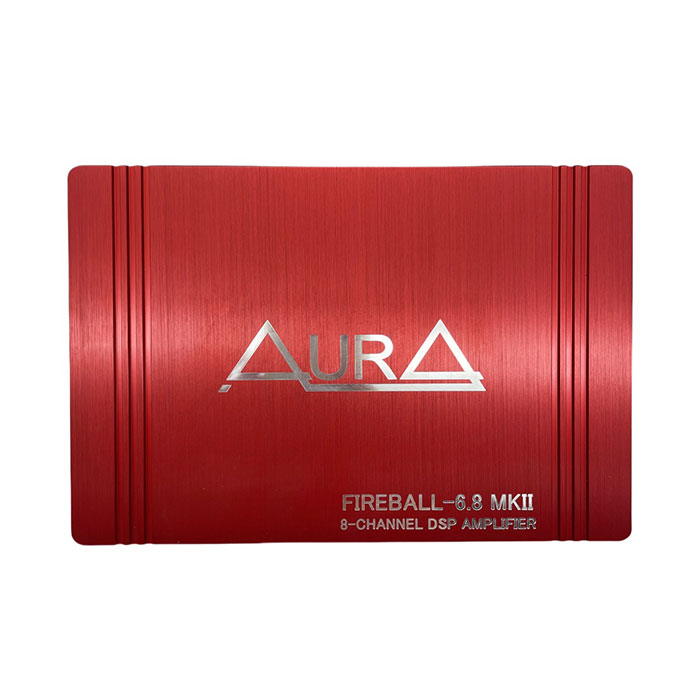
The Aura Venom DSP Series targets high-performance builds with more channels and processing power. The Aura Fireball DSP Series sits mid-range, balancing features and price for typical enthusiast builds. The Aura Indigo DSP Series covers entry and mid-spec with solid DSP functionality at a more accessible price point.
Count the independent channels needed - each tweeter, midrange, woofer, and subwoofer that needs independent processing counts as one channel. Front components plus rear speakers plus sub typically need 5-8 channels minimum, depending on configuration.
Through our service network at Enigma, professional tuning makes a significant difference over self-tuning without measurement tools, particularly for time alignment and parametric EQ, which need real acoustic measurements.